Why the Best AI Agents Win on Integration, Not Just Model Quality
· Paul Chada · 6 min
The model leaderboard will change again next quarter. Your CRM, ERP, email, and collaboration stack will not. Enterprises get better AI results when agents can work across systems, complete multi-step workflows, and operate with audit trails and human control.
Google Cloud recently made a useful point for buyers: the winning AI stack will not be built around a single model vendor. It will be built around choice, interoperability, and the ability to connect AI to the systems where work actually happens.
That matters because if your AI agent cannot read from Salesforce, update SAP, send through Microsoft 365, coordinate in Slack, and call your internal APIs, model quality alone will not save the project.
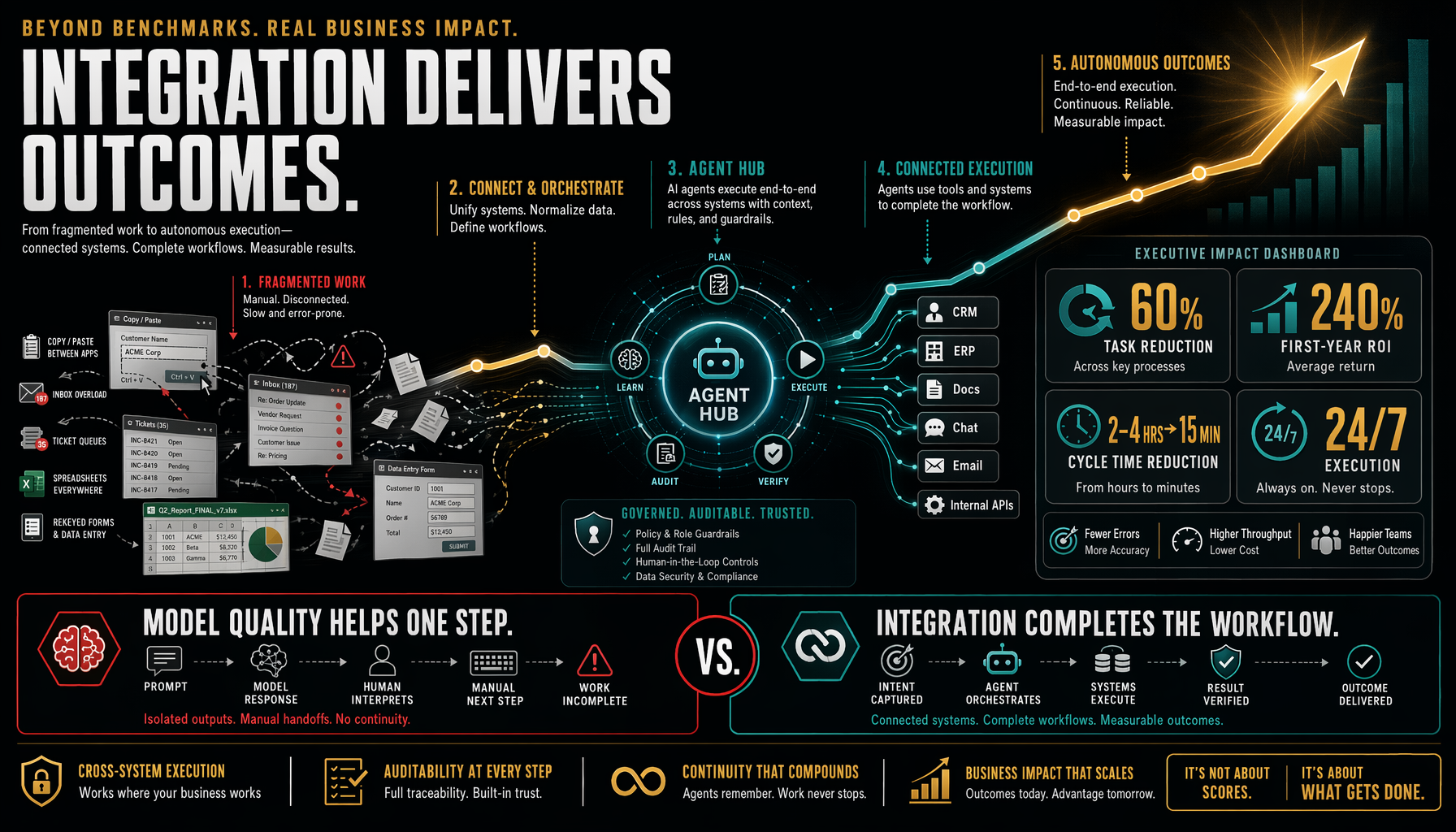
For enterprise teams, the cost of poor integration shows up fast. Analysts still spend hours copying data between systems, support teams rekey information across tools, compliance staff chase documents in inboxes and shared drives, and operations leaders pay for delays, errors, and missed SLAs. A smarter model can improve one step. An integrated agent can complete the workflow.
The real problem: great models fail inside disconnected operations
Most enterprise work is cross-system by default. A lead starts in a form, gets enriched from a data source, routed in a CRM, approved in email, discussed in Teams or Slack, and logged into an ERP or ticketing platform. If an AI tool only answers questions or generates text, the human still has to do the handoffs.
That is why model benchmarks are an incomplete buying criterion. The best AI agents reason, plan, use tools, and execute across systems with auditability and controls. They do not stop at “here is the answer.” They take the next action, then the next one, and document what happened.
DoozerAI was built for that operating reality. Its Agent Operating System gives digital workers access to seven core tool types: HTTP, Python, LLM, Knowledge/RAG, Workflow, MCP/native integrations, and Email. That means agents can query knowledge bases, call APIs, run code, orchestrate multi-step processes, and work across the business stack rather than sitting beside it.
What buyers should look for in an integration-first AI agent platform
A serious evaluation should start with architecture, not demos. Ask whether the platform is API-first, whether it supports both packaged integrations and custom endpoints, and whether agents can work across systems in one run without brittle scripts.
With DoozerAI, that connectivity spans HubSpot, Salesforce, Microsoft 365, Google Workspace, SAP, Box, Dropbox, ServiceTitan, Slack, Teams, Zendesk, Jira, and more. For technical teams, the important point is not just the logo grid. It is that agents can combine those systems with custom APIs and internal knowledge in the same workflow.
That matters because enterprise automation is rarely linear. A due diligence agent may pull data from a CRM, search internal policy docs, validate a sanction list through an external API, generate a summary, and email the result for approval. A compliance agent may monitor deadlines, gather documents from shared storage, update a case system, and escalate exceptions in Teams. Those are agentic workflows, not static automations.
Why integration matters more than the hottest model this quarter
Model quality still matters. But for enterprise ROI, integration breadth and execution depth usually matter more.
Here is why. Models change fast. Your operating environment does not. CRM, ERP, email, ticketing, document systems, and collaboration platforms remain the backbone of execution. If your AI platform is tightly coupled to one model but weak on integration, every process improvement hits a wall at the system boundary.
If your platform is integration-first, you gain flexibility. You can swap or upgrade models over time while keeping the workflow, controls, and system connections intact. That is a better long-term architecture for CTOs and IT leaders who care about resilience, governance, and cost control.
DoozerAI is designed for that. It supports full APIs, multi-region deployment, auto-scaling from 1 to 50+ agents, and enterprise controls that make autonomous execution usable in production. Buyers do not need to choose between agentic capability and accountability. They get both.
Results come from execution, not demos
The case for integration-first AI is practical: it produces measurable operating results.
Across deployments, DoozerAI customers see 60% task reduction, 24/7 execution, and 240% first-year ROI. In specific workflows, the gains are sharper. KYC and due diligence work can drop from 2–4 hours to 15 minutes. Compliance teams can reach 100% on-time filings. Order processing environments have seen 65% fewer status calls because agents keep systems updated and communication moving.
Those outcomes come from connecting the workflow end to end. Not from generating a better paragraph.
For teams comparing options, the best next step is to review use cases, explore the features, and assess how quickly agents can plug into your environment through the developers page. If you want a walkthrough of how this works in your stack, contact DoozerAI.
FAQ: integration-first AI agents
Why is integration more important than model quality for enterprise AI agents?
Because most enterprise work spans multiple systems. A strong model can generate an answer, but an integrated agent can complete the task across CRM, ERP, email, collaboration, and internal APIs. That is where time savings and ROI come from.
What systems does DoozerAI connect to?
DoozerAI connects to HubSpot, Salesforce, Microsoft 365, Google Workspace, SAP, Box, Dropbox, ServiceTitan, Slack, Teams, Zendesk, Jira, and more. It also supports custom APIs, knowledge sources, email actions, code execution, and workflow orchestration.
Can DoozerAI handle autonomous multi-step workflows, or is it just rule-based automation?
It is an agentic AI platform. DoozerAI agents reason, plan, use tools, and execute multi-step workflows independently, with audit trails and human-in-the-loop controls built in.
What ROI can teams expect from integration-first AI agents?
DoozerAI deployments have delivered 60% task reduction and 240% first-year ROI, with use-case-specific gains such as reducing due diligence work from 2–4 hours to 15 minutes.
How quickly can a team get started?
Most teams are live in days, not months. You can review the Agent Builder, explore solutions, or book a demo through contact.
Start with the architecture that will still make sense next year
The best AI agents do not win because they are attached to the noisiest model release. They win because they connect to the systems that run the business and can act across them reliably.
If you are buying for production, prioritise integration, control, and execution. Book a demo or explore how the Agent Operating System works in practice.
---
<sub>3f45d363</sub>